AI Search Showdown: Perplexity vs ChatGPT Search vs Google AI Mode
AI Search Showdown: Perplexity vs ChatGPT Search vs Google AI Mode
For most everyday questions, Google AI Mode is a sensible starting point, ChatGPT search is strong when you need to talk a problem through, and Perplexity is strong when you want to read the sources yourself. None of them is reliable enough to skip the sources.
Disclosure: This piece is from the ToolPotion Media Team. ToolPotion is our product. This tracks our AI search comparison. Hashnode applies nofollow ugc to links.
What changed: money, not just models
Independent tests in 2025 and 2026 found wrong or unsupported answers in a large share of responses across vendors. What changed this year is also commercial. ChatGPT has shown ads to Free and Go users. Google has ads inside AI Mode. Perplexity went the other way and dropped advertising in the period we covered. So the choice is no longer only about answer quality. It is also about who pays for the answer you are reading.
What each product is in 2026
Perplexity is an answer engine built around citations. Its positioning promises citations in answers, with numbered links back to sources. It also ships Comet, a Chromium-based browser with an assistant; Comet launched for high-end subscribers and later broadened access. Perplexity Computer (agent product) is outside this comparison.
ChatGPT search is a mode inside ChatGPT, not a separate site. It searches when a question needs current information, or you can switch it on. It works across plans; OpenAI has also described signed-out use. OpenAI's browser efforts (Atlas) sit beside, not instead of, search-in-chat.
Google AI Mode is a tab inside Google Search. Google describes query fan-out: splitting a question into subtopics and searching each. It accepts text, voice, images, files, and pasted URLs, with broad country availability. AI Overviews remain the shorter summaries in classic results; AI Mode is the deeper tab experience.
One-hour evaluation protocol
Run the same five queries on each tool:
- Stable factual (versions, dates).
- Local/business.
- Contested topic with disagreeing sources.
- Code/error.
- "What changed recently?"
Score citation quality, freshness, hedging ("I don't know"), and follow-up friction. Keep a notes table. Do not crown a winner from one restaurant query.
Quick picker
- Shopping / local / "just get me oriented": start with Google AI Mode, then open two classic results.
- Iterative debugging or strategy chat: ChatGPT search inside a thread.
- Brief with sources you will actually read: Perplexity.
- Private PDF corpus: not these — use NotebookLM/Projects instead (comparison).
Publisher and developer side effects
AI answers change click-through. If you publish, read getting found in AI answers. If you draft after research, that is a writing-tool problem, not a search problem — see writing assistants.
Failure modes
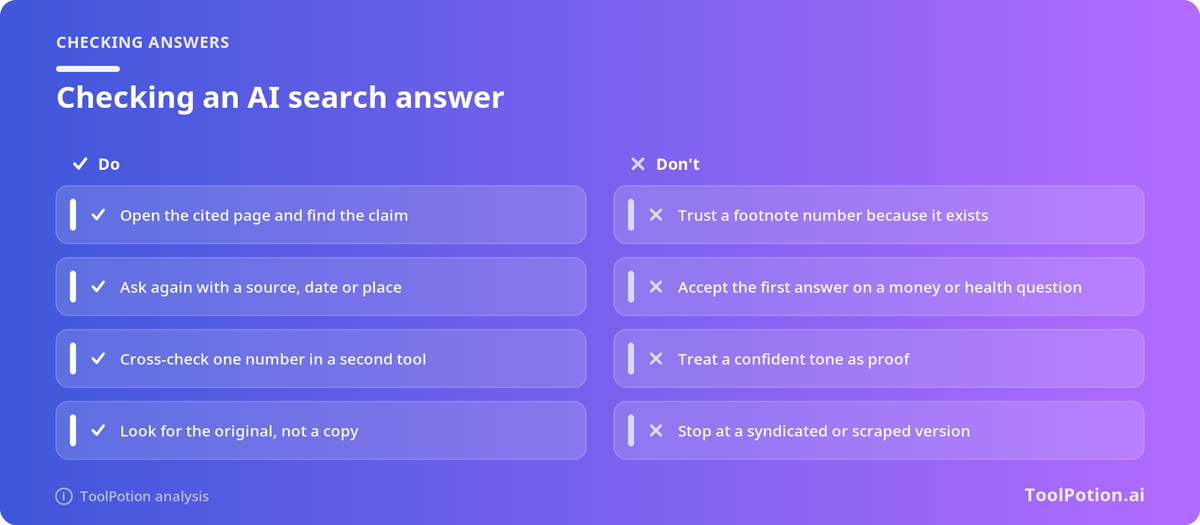
- Trusting fluent prose without opening citations.
- Using AI search for compliance decisions without primary docs.
- Ignoring ads and personalization as ranking influences.
- Assuming chat mode and search mode from the same brand behave identically.
A sane daily routine
Use AI search to build a source list in minutes. Open the best two sources. Then write. Save the prompts that produce good source lists so teammates stop reinventing them. For recurring topics, keep a short "known good queries" doc next to your team wiki.
Practical takeaways
- Match tool to habit: Google ecosystem, chat follow-up, or citation-first.
- Evaluate with a fixed query set.
- Separate web AI search from private-corpus tools.
- Always click through before shipping decisions.
Longer guide: Perplexity vs ChatGPT Search vs Google AI Mode.
Accuracy expectations you should budget for
Wrong or unsupported answers show up often enough across vendors that "just trust the box" is not a workflow. Budget time to open sources the same way you budget time for code review. If a teammate pastes an AI-search paragraph into a customer email without links, that is a process bug. Require two source clicks for external-facing claims.
When studies disagree, they still agree on the shape of the problem: fluency is cheap, grounding is hard. Your evaluation protocol with five query types is how you see where each vendor fails for your domain, not for a generic blog demo.
Ads, ranking, and why it belongs in the comparison
If an answer unit is ad-supported, incentives differ from a subscription-only answer engine. That does not make the answers automatically bad. It does mean you should notice sponsored placements and still click organic sources for anything that costs money or reputation. Perplexity's move away from ads in the period we covered is part of its product story; Google and ChatGPT's ad surfaces are part of theirs. Put "who pays?" on the same scorecard as "who cites?"
Coding and technical queries
For stack traces and library APIs, AI search can propose a fix quickly and still invent an API method. Prefer official docs links in the citation list. If citations are thin, switch to the library's own documentation site and use the model only as a reader once you pasted the relevant page. That hybrid is slower by thirty seconds and faster by one avoided outage.
Keep a short allowlist of documentation domains your team trusts. When an answer cites only SEO content farms, discard it and rerun with a site-limited mental filter, or use classic search operators.
Building an internal cheat sheet
Create a one-pager: which tool for which job, five standard test queries, link to the privacy tier list, and a reminder to export important threads weekly. New hires should find it on day one. Without it, everyone reinvents a personal stack and your company quietly pays for three overlapping subscriptions.
ToolPotion Media Team
About the author
- We're a small team behind ToolPotion, an AI tools directory. We write about choosing tools, what's working in AI right now, and the lessons we pick up running a directory. toolpotion.ai
Comments
Join the discussionOne useful extra control is to treat each query run as a sample, not a verdict: hold wording, locale, language, signed-in state, and mode constant, then repeat the same prompt across several days. Save the exact prompt and timestamp alongside the cited URLs, not only the brand mention, since a citation to the page you’re evaluating is a different outcome from a mention or a homepage link. I’d compare citation frequency and source overlap over a rolling window; for technical queries, verify each cited claim against the primary documentation. This makes the five-query test much easier to reproduce when answers fluctuate.